
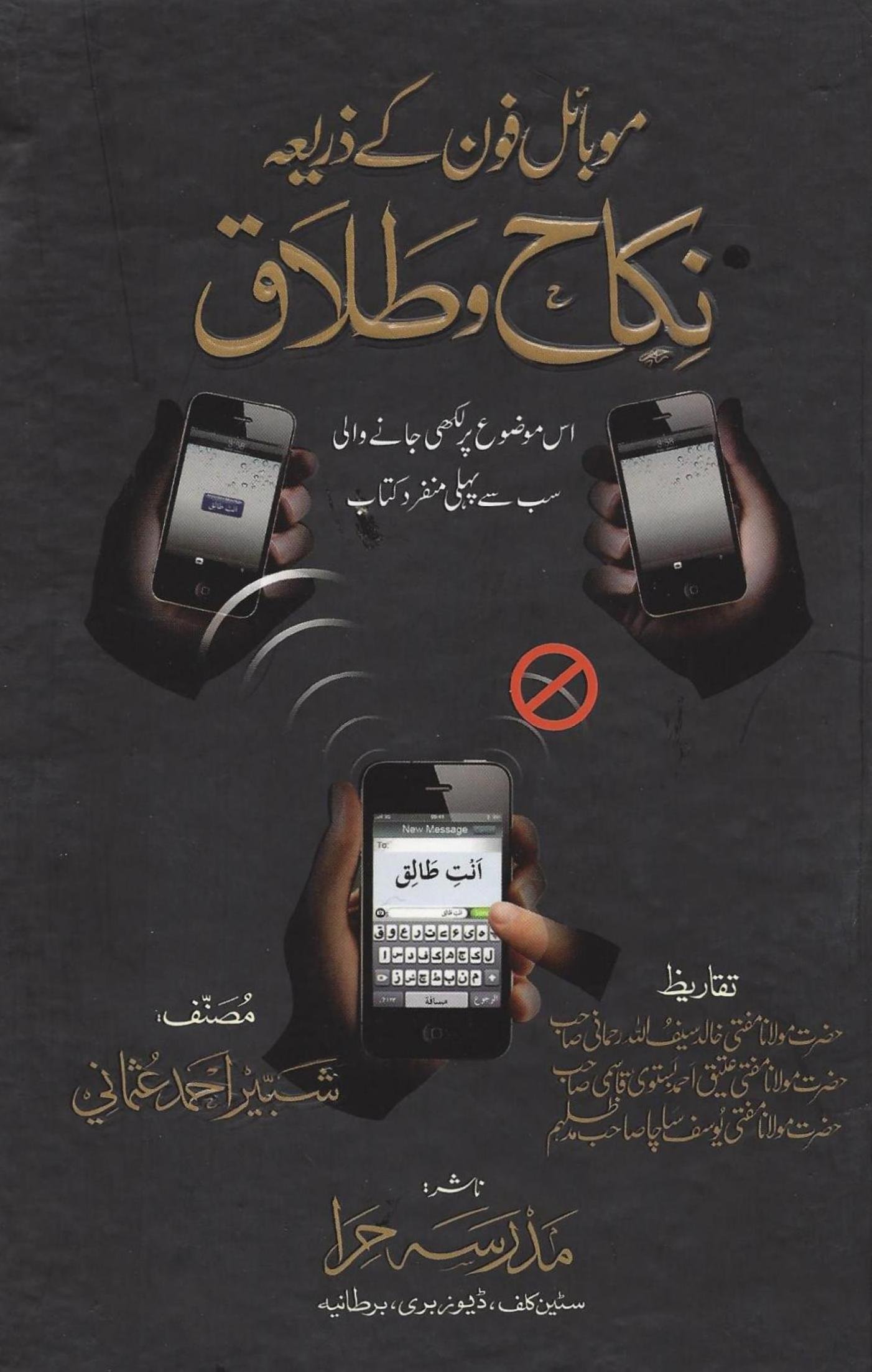
Mobile Phone kay Zariya Nikah o Talaq By Maulana Shabbir Ahmad Usmani Read Online Free Download in Pdf format.
Mobile Phone kay Zariya Nikah o Talaq By Maulana Shabbir Ahmad Usmani. The book is the first unique research effort on a highly sensitive, important, and modern jurisprudential issue of the present era. The author of this book is a talented and insightful British religious scholar who has presented the guidance of Islamic Sharia in the context of modern scientific discoveries with great seriousness, caution, and scholarly integrity.
Islam is a comprehensive and universal religion that offers solutions to the problems of every era and time. Thanks to the clear teachings of the Book and Sunnah and the great scientific legacy of the jurists of the Ummah, the Muslim Ummah has been guided on every new issue that arises. In the present era, while mobile phones and modern media have facilitated human life, they have also given rise to many new Sharia questions, especially in sensitive and important matters like marriage and divorce.
Issues such as marriage and divorce through mobile phones, messages, calls, audio, video, and written means of enforcing Shariah rulings have become common among Muslims today. What is the Shariah status in these matters? In which cases will marriage or divorce take place, and in which not? How will basic jurisprudential principles such as intention, words, witnesses, and the marriage assembly be applicable to modern means? These are questions that have become the need of the hour to answer.
Maulana Shabbir Ahmed Usmani, in the light of his jurisprudential taste, deep insight, and extensive study, has combined all these occurring and possible questions and presented clear and reasoned answers to them in the light of the authoritative statements of the jurists, the principles of jurisprudence, and the Book and Sunnah. The book is not only useful for scholars, students of knowledge, and muftis, but also serves as a guiding document for ordinary Muslims.
This book is an excellent example of the integration of modern technology and Islamic Shariah, demonstrating that Islam is fully capable of meeting the requirements of every era. Undoubtedly, this work is a valuable addition to understanding the issues of marriage and divorce in the present era.